.svg)



- USA
- Software
- 700+
- Remote


How a PE-Backed Software Company Lifted Productivity 40% by Proving Engagement Drives Profit
By partnering with Insightful, a PE-backed software company moved from gut-feel management to data-driven leadership, and proved that team engagement directly drives productivity at scale:
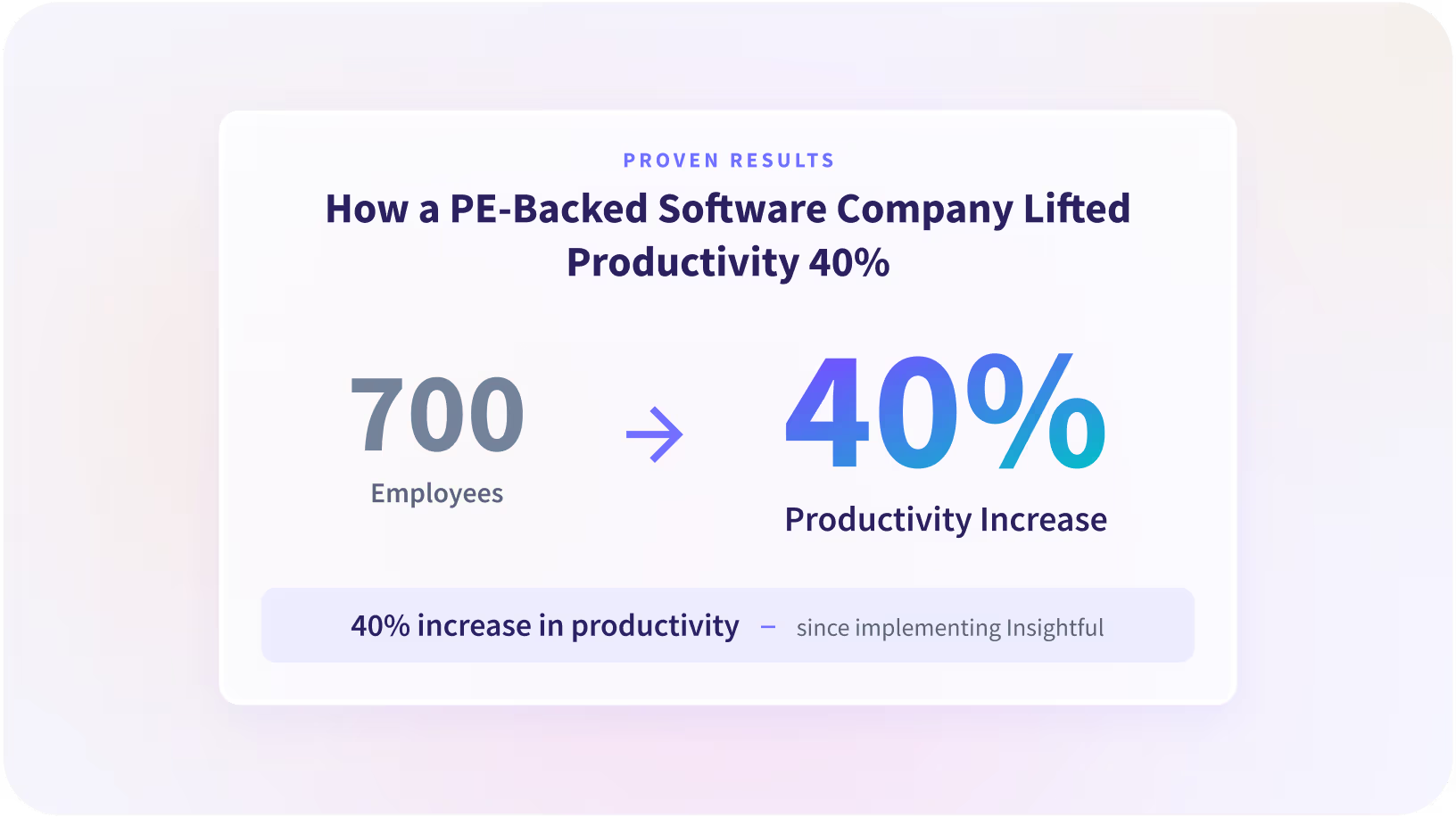
- 40% increase in productivity since Insightful implementation
- Proved the “service-profit chain” across 700 employees: engagement drove productivity, productivity drove profitability
- Translated productivity and ARR-per-employee metrics directly into EBITDA
- Built the evidence base necessary for their AI transformation

Results with Insightful


- USA
- Software
- 700+
- Remote
THE CHALLENGE
Managing Remote Performance on Instinct, Not Evidence
Leadership knew work effort was unevenly distributed across the company, but lacked a consistent way to distinguish that perception from evidence. In a largely remote workforce, managers were coaching on instinct and executives were making staffing decisions on a hunch.
Employee perception filled the vacuum. A company-wide engagement survey revealed that 85% of employees believed their colleagues weren’t working as hard as them. That type of widespread perception suggests a serious trust and fairness problem.
The company’s CHRO knew introducing workforce analytics could come with friction. Measurement tools can quickly be perceived as surveillance if leaders are unclear about intent, access, and use. But the business stakes were too high to ignore.
“The default position on this kind of tool is that it doesn’t feel fair,” the company’s CHRO said. “But we’re in an environment where we have to serve our customers and make sure everyone works a full day. This tool gives us the insight on whether that’s happening, and then lets us coach people who aren’t leaning in as their colleagues are.”
The company pointed to the engagement survey results to demonstrate to its employees the need for Insightful’s workforce analytics data. The rollout was designed around transparency: managers first, then every employee, with each person given full visibility into their own day. The bet was that openness, not surveillance, would earn trust.
THE SOLUTION
Exposing the Imbalance & Rewiring How Managers Lead
Once Insightful’s work intelligence platform was live, it showed the perceived work imbalance wasn’t just real. It was even bigger than expected.
Some employees were working three to four hours a day. Others were working eleven or twelve. At the team level, the gap was just as wide: some functional teams averaged five productive hours a day, others averaged eleven.
The data didn’t prove people were lying about their work. It proved that in a fully remote organization, no one had the visibility to see how work was distributed. The system was invisible until Insightful made it tangible.
With the imbalance now measurable, leadership could act. Workloads were rebalanced at the system level. Teams running hot got relief. Teams running cool got accountability. But the more important shift was behavioral.
Managers began leading differently. Coaching conversations that used to rely on perception were now anchored to real activity patterns. The data exposed dynamics no manager could see on their own:
- High-performers flying under the radar at risk of burnout
- Teams with excess capacity that hadn’t been visible to senior leadership
- Managers whose perceived performance did not match the operating reality of their teams
- Disengaged managers whose teams were excelling anyway
Each pattern became a coaching opportunity, and over time, a new input for how the company identifies and develops its next generation of leaders.
To keep the program fair, the company anchored measurement on utilization rather than narrow activity metrics. Utilization captures total productive time, including passive and off-keyboard work, giving a truer picture of someone’s day than keystroke counting ever could.
Employee surveys after the rollout confirmed the cultural shift. People reported feeling that workload distribution had become more fair, not less. The transparency-first rollout was working.
The Moneyball Moment
Then came the discovery that elevated the initiative from an operational fix to strategic insight.
The CHRO’s team cross-referenced two data sets they had never aligned before: Insightful’s productivity metrics and the company’s engagement survey results. They were looking for a correlation.
They found one. And then some.
Across all 700 employees, the groups with the lowest productivity scores also had the lowest engagement. The relationship tracked almost like a linear regression all the way to the highest-engaged, highest-productivity groups.
A concept that had lived in business school case studies was suddenly validated in real time, within the company’s own ops data: the service-profit chain. Developed by three Harvard Business School service firm experts, the service-profit chain is the idea that quality drives profit. It draws a direct connection between employee satisfaction, customer loyalty, and profitability.
And now, for this rapidly scaling software company, it wasn’t a theory anymore. It was a finding.
From Flying Blind to AI Readiness
In an AI-first economy, the company cites Insightful’s data precision for enabling their own AI transformation. Insightful helped the company’s leaders answer questions that every AI strategy now requires:
- Which teams are overloaded and would benefit most from AI-enabled workflow support?
- Where are employees spending time on repetitive or low-value work?
- Which managers are building engaged, productive teams that may adopt AI more effectively?
- Which productivity gains can be connected to customer outcomes, ARR per employee, or EBITDA?
Companies that understand work can make better AI decisions, identifying where AI can remove friction, where human judgment remains essential, and where productivity gains can flow to customers, employees, and financial performance.
The executive takeaway is simple: AI readiness is not just a technology question. It is an organizational capability and change management question. Companies need precision work intelligence data if they want to translate their AI investment into a true operating advantage.
THE RESULTS
Productivity Up 40%, Engagement Proven to Drive It
By exposing imbalance, rebalancing workloads, and equipping managers to coach on data instead of instinct, the company delivered measurable gains across the organization:
- 40% increase in productivity
- Near-linear correlation between engagement and productivity, validated across all 700 employees
- Higher productivity-per-employee benchmarks reported to the executive team and board
- Stronger employee perception of workload fairness across a remote workforce
- Significant increase in per-employee ARR quarter-over-quarter
- AI readiness, with analytics allowing leaders to identify opportunities with highest AI ROI impact
For a PE-backed company where workforce cost is one of the largest line items on the P&L, the financial framing matters as much as the cultural one. Every industry has benchmarks for productivity, revenue, and ARR per employee. Moving those benchmarks even modestly translates directly to EBITDA. Moving them by the magnitude the company achieved translates to a different financial profile entirely.
But the most strategically important outcome was a new operating principle: the company now knows, with data, that engaging employees better is the path to higher productivity. The link between manager effectiveness, engagement, and business outcomes is no longer a hypothesis to argue for in performance reviews. It’s a finding the entire company builds on.
That correlation is now a permanent input to how the company evaluates manager effectiveness, develops leaders, and reports performance to its board. Today, Insightful is core infrastructure.


