.svg)


.avif)


On this page
Measure the work, not the signal.
See productive time and utilization by team, not just what looks active.


Key Takeaways:
- Data entry outsourcing frees internal teams to focus on higher-value strategic work by delegating repetitive, high-volume input tasks externally.
- The right time to outsource data entry is when data volume exceeds internal capacity, accuracy drops, or the core team’s focus is consistently disrupted.
- Choosing an outsourcing partner requires evaluating experience, data security standards, quality assurance processes, and communication reliability before committing.
- ROI from data entry outsourcing depends on visibility into how outsourced work flows, where delays occur, and how performance compares to benchmarks.
- Workforce analytics platforms help manage outsourced data entry by providing clear visibility into productivity, capacity, and process performance across distributed teams.
Data entry outsourcing is no longer just about cutting costs: it shapes how efficiently work gets done, how fast teams move, and how well your organization uses its time. In fact, outsourcing is no longer on the sidelines of operations. Organizations now count outsourced teams and contractors as part of their core workforce, not as an extension.
Most businesses already see the value of outsourcing data entry services to handle repetitive work. But the real question is simpler and far more important: Is work actually being done well, and is it driving results? That question matters even more as data entry outsourcing scales. Around 80% of executives plan to maintain or increase investment in outsourcing, showing how central it has become to modern operations.
This growing reliance is also reflected in market size, with the global business process outsourcing (BPO) market projected to reach $525.23 billion by 2030. As outsourcing becomes more widespread, the focus naturally shifts from weighing in its adoption to measuring its effectiveness, making it critical to understand how well the work is actually being done and where improvements are needed.
The Evolving Landscape of Data Entry
Data entry outsourcing has gone through a quiet but important shift. What started as a manual, in-house task has moved to outsourced models and is now evolving into something more optimized and data-driven.
As data volumes continue to grow, so does the need to process them accurately and at scale. Remote work has made it easier to outsource data entry services globally, while advancements in AI have increased the demand for high-quality, structured data.
This has pushed data entry beyond a simple administrative function. It now plays a direct role in how efficiently businesses operate and how well they can scale. Yet many organizations are still stuck in the middle of this shift. They invest in data entry outsourcing benefits, but don’t have clear visibility into how the work is actually being done.
That’s why the next phase of data entry outsourcing isn’t just about delegating tasks. It’s about optimizing workflows with clear visibility into productivity, so leaders can understand how work flows, where time is spent, and how it connects to business outcomes.
Ask the Right Questions to Find the Right Data Entry Provider
Choosing a data entry outsourcing partner isn’t just about cost or capacity—it’s about how well that partner fits your way of working and how clearly you can understand their performance.
To accomplish that, it helps to go beyond surface-level questions and dig into how work is actually managed.
Here are a few important questions to ask:
- What tools and systems does the BPO partner use to deliver work?
- How easily can you communicate across time zones and teams?
- How is productivity measured, and what metrics are used to track performance?
- What visibility will you have into workflows and output?
It is also worth asking for examples of past work, especially projects similar to yours. This gives you a clearer sense of how the data entry outsourcing partner operates and whether they can meet your expectations.
Security should be part of the conversation from the start. Ask how your data will be handled, stored, and protected. Make sure there are clear protocols in place for access control, encryption, and compliance.
Finally, discuss their approach to risk. What happens if something goes wrong? Do they have backup systems and recovery plans in place?
The goal is simple. You are not just hiring a vendor. You are building an extension of your team. And the more visibility you have into how they work, the easier it becomes to realize the full data entry outsourcing benefits.
Measuring ROI on Outsourced Data Entry
Asking the right questions of a potential outsourcing partner is all in service of one overarching objective: will you be able to clearly measure your return on investment?
Without defined metrics, data entry outsourcing ROI can feel strong on paper but fail to deliver real value. A simple decision framework can help bring clarity:
1. Cost comparison
Start by comparing in-house costs with outsourced costs. This includes salaries, infrastructure, and management time versus vendor pricing. The goal is to understand true savings, not just hourly rate differences in data entry outsourcing costs.
2. Productivity metrics
Look at how much work is being completed, and how quickly. Metrics like output per hour and turnaround time help you see whether data entry outsourcing is improving speed and efficiency.
3. Quality metrics
Cost and speed mean little without accuracy. Track error rates, reworks needed, and consistency of output. This ensures that efficiency is not coming at the expense of quality.
4. Visibility into workflows
This is often the missing layer. Understanding how work is done, where time is spent, and where delays occur gives context to all other metrics. With the right visibility tools, you can see what is working and where improvements are needed.
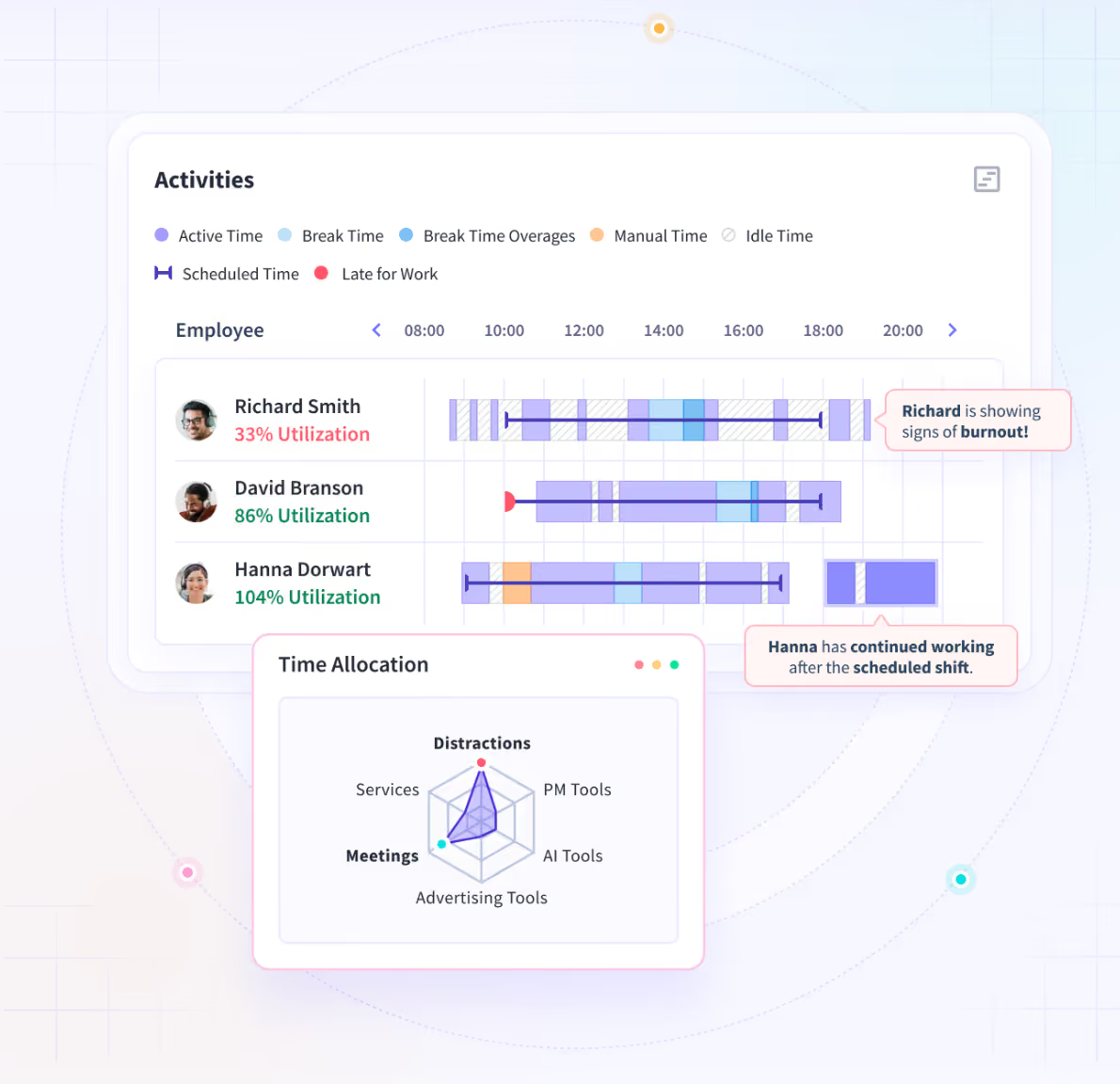
A work intelligence platform like Insightful helps bring this together by giving a clear view of productivity, workflows, and capacity across teams, making it easier to identify gaps and improve performance without relying on assumptions.
And since ROI is everything, you can use Insightful’s ROI calculator to instantly determine how much those performance gaps are currently costing your business.
Conclusion
Data entry outsourcing can save costs and free up your team’s capacity. But the real value comes from how well that work is managed and improved over time.
Visibility makes the difference. When you can clearly see how data flows, how teams spend their time, and where things slow down, data entry outsourcing ROI becomes easier to achieve. It shifts from a cost decision to a performance advantage.
Platforms like Insightful help make that shift by turning everyday work into clear, useful insights. With the right visibility in place, you are not just choosing to outsource data entry services. You are building a smarter, more efficient way of working.
Book a demo with our team to learn how Insightful can help improve your operational decision-making at scale.
FAQs
Is outsourcing data entry cost-effective?
Yes, outsourcing data entry can be cost-effective when done right. It often reduces labor and infrastructure costs while freeing internal teams for higher-value work. However, the real savings depend on how well the outsourced work is managed. Without visibility into productivity and quality, lower costs can be offset by inefficiencies or rework.
How do you measure ROI for data entry outsourcing?
ROI is measured by comparing cost savings with improvements in productivity and quality. Key metrics include output per hour, turnaround time, and error rates. It is also important to track how much internal capacity is freed up. Visibility into workflows helps explain where value is being created or lost.
What are the risks of outsourcing data entry?
The main risks include data security concerns, inconsistent quality, and lack of control over workflows. Communication gaps and time zone differences can also slow down execution. These risks increase when there is limited visibility into how work is performed and how performance is tracked.
Is outsourcing better than in-house data entry?
It depends on the nature of the work. Outsourcing is often better for repetitive, process-driven tasks, while in-house teams are better suited for strategic or sensitive work. The best approach is usually a mix of both, supported by clear visibility into performance across teams.
What tools help manage outsourced data entry teams?
Tools that provide visibility into productivity, workflows, and time usage are essential. Platforms like Insightful help track how work is done across teams and locations, making it easier to manage performance, identify bottlenecks, and ensure consistent output without relying on manual reporting.

.webp)
.webp)


