.svg)


%20(1).avif)


On this page
Measure the work, not the signal.
See productive time and utilization by team, not just what looks active.


Key Takeaways:
- Onshore outsourcing uses domestic talent for maximum control and communication alignment, but at higher labor cost than alternatives.
- Nearshore outsourcing hires from geographically close countries with overlapping time zones, balancing cost savings and operational collaboration effectively.
- Farshore and offshore models can deliver the highest cost reductions but require stronger coordination infrastructure to manage large time zone gaps.
- Asynchronous work becomes the default in farshore models, adding latency to feedback cycles and compounding execution risk when workflows are unmapped.
- Workforce visibility tools are essential in any outsourcing model to maintain productivity standards, accountability, and delivery consistency across distributed teams.
Outsourcing is no longer just a cost decision. Outsourcing decisions affect margins, delivery timelines, and how effectively teams operate at scale. Most organizations evaluate these decisions using cost, talent availability, and time zones. Those factors matter, but they only tell part of the story.
The harder question is how work flows across distributed teams, where time is actually spent, and whether that effort produces measurable outcomes. Without that visibility, even the right outsourcing model can underperform.
There are four primary outsourcing structures. Each comes with real trade-offs across cost, control, coordination effort, and visibility. Understanding those trade-offs before you commit is what separates a well-managed outsourcing decision from one that looks good on paper but struggles in practice.
At a glance:
Nearshore Outsourcing
Nearshore outsourcing means hiring from countries close to your own, typically within one or two time zones. It offers a middle position in the nearshore vs. offshore vs. onshore decision: labor costs are lower than domestic hiring, and operational friction is lower than farshore models.
Because teams work in overlapping hours, communication is faster, and alignment is easier to sustain. This tends to produce more predictable delivery cadences and fewer execution delays than farshore or offshore setups.
The constraint is cost. Nearshore labor rates sit between domestic and offshore, so the savings are moderate. For large-scale operations where cost reduction is the primary driver, the margin may not justify the model.
Where nearshore works well:
- Teams that need real-time collaboration and fast feedback loops
- Projects where quality control requires frequent communication
- Organizations willing to pay a cost premium for operational simplicity
Where it falls short:
- Cost-sensitive operations where offshore savings are material
- Roles requiring highly specialized global talent that isn’t available in nearby markets
Day's Motor Group, Wales's largest dealership group, with 600+ staff across 19 sites, used Insightful to preserve productivity standards when administrative roles shifted to remote work. This gave managers the same visibility they had on the showroom floor, without requiring physical presence.
Offshore Outsourcing
Offshore outsourcing covers hiring from any country other than your own, regardless of distance. It gives organizations access to a global talent market, allowing them to optimize for both skill and cost without being constrained by geography.
This flexibility is the core argument for offshore. Organizations can access specialized capabilities, scale teams quickly, and reduce labor costs compared to onshore models. These advantages explain why offshore outsourcing is a central variable in most onshore vs. offshore outsourcing decisions.
The variability in execution is the offsetting risk. Offshore teams are not inherently less productive, but performance across distributed models depends heavily on how clearly work is defined, tracked, and managed. Without that infrastructure, output inconsistency is common.
Where offshore works well:
- Technical roles, software development, and data functions with global talent depth
- Organizations with established remote management processes and visibility tools
- Cost-reduction initiatives where labor arbitrage is the primary lever
Where it falls short:
- Teams without clear workflow documentation or performance measurement
- Work that relies on tacit knowledge, close collaboration, or real-time coordination
When COVID lockdowns pushed Grapes Digital's workforce remote overnight, the agency lacked visibility into whether employees were working productively. They deployed Insightful company-wide for time, attendance, and productivity tracking, using it as a supplementary analytics tool rather than active surveillance.
Onshore Outsourcing
Onshore outsourcing keeps hired teams within the same country. Shared time zones, cultural context, and business norms reduce coordination friction. Performance is easier to manage, communication is faster, and quality control tends to be more consistent.
The trade-off is cost. Onshore labor carries the highest expense of any model, which directly compresses margins in cost-sensitive operations. This is the central tension in any onshore vs. offshore outsourcing comparison.
Onshore makes sense when alignment and control outweigh cost. Regulatory environments, customer data sensitivity, or specialized local knowledge requirements can all tilt the decision in this direction, regardless of price.
Where onshore works well:
- Regulated industries where compliance requires domestic operations
- Client-facing or brand-sensitive work where cultural alignment is critical
- Senior or strategic roles where deep integration with the business is required
Where it falls short:
- High-volume, repeatable work where cost is the dominant factor
- Scaling quickly without a proportional increase in labor spend
Caduceus Health, a US-based revenue cycle management firm, replaced manual tracking and spreadsheets with Insightful's real-time analytics. As a result, call abandonment dropped from 14% to 3%, and teams accomplished 20% more productivity.
Farshore Outsourcing
Farshore outsourcing targets distant regions, typically to access the lowest available labor costs and the widest talent pool. India, Eastern Europe, and Southeast Asia are common farshore destinations for organizations headquartered in North America or Western Europe.
The cost case is clear. Labor rates are substantially lower, and the talent pool is large enough to fill specialized roles at scale. For organizations with high-volume or commodity workflows, farshore can reduce operating costs significantly.
The challenge is coordination. Large time zone gaps mean asynchronous work across time zones becomes the default, which adds latency to feedback cycles, decisions, and issue resolution. When workflows are unmapped or accountability is unclear, that latency compounds into execution risk.
What looks like cost efficiency can become operational overhead if the management infrastructure is not built to support it.
Where farshore works well:
- High-volume, well-defined workflows that do not require real-time coordination
- Organizations with the management systems to track performance across time zones
- Functions where deep specialization is available at a lower cost globally
Where it falls short:
- Work that requires daily synchronous collaboration
- Teams without visibility into how work flows or where delays originate
Peach Payments needed objective visibility into remote workloads to convince leadership that a remote-first model could drive results. After adopting Insightful, remote-first teams that had been hidden on performance dashboards emerged as overachievers, contributing to 40% business growth.
Which Type of Outsourcing Is Best for Your Business?
Most outsourcing decisions in the nearshore vs. offshore vs. onshore vs. farshore debate are made using:
- Cost
- Talent availability
- Time zones
- Cultural alignment
While these are necessary starting points, they are not sufficient on their own.
The decision that actually determines performance is how well you can see and manage work once teams are in place, whether those teams are nearshore, offshore, or onshore.
Without workflow visibility, organizations make staffing and capacity decisions based on assumptions. This is where workload gaps in distributed teams emerge, where delivery timelines slip, and where the cost savings of a lower-priced model get consumed by coordination overhead and rework.
A lower-cost offshore team may appear efficient based on hours logged. But if workflows are unmapped and performance is not measurable at the process level, the true cost can exceed what a nearshore or onshore model would have cost.
The right model is one where cost, talent, and structure align with your management capabilities. Insightful’s guide on choosing the right outsourcing partner walks through the key questions to ask before committing to any model.
Why Visibility Matters Across All Outsourcing Models
Location does not determine performance. Visibility does.
As teams become more distributed, work spans multiple tools, time zones, and roles. Without a clear view of how work happens, leaders cannot manage capacity or outcomes reliably. This is especially true for workflow optimization across outsourced teams, where the feedback loops that exist naturally in co-located settings need to be built deliberately.
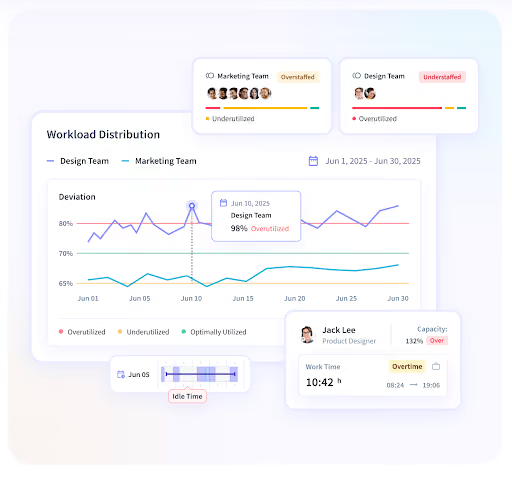
Insightful provides visibility into how work flows across applications, teams, and locations. Leaders can see where time is spent, how workloads are distributed, and where inefficiencies concentrate. This makes it possible to manage any outsourcing model for actual performance rather than assumed performance.
Location sets the conditions. Visibility determines what you can do with them.
Managing Outsourced Teams for Performance
Choosing the right outsourcing model is the first decision. Managing performance across it is an ongoing process. These four steps apply across all models:
- Identify the workflows that most directly affect revenue and delivery. These are the processes where visibility matters most and where unmapped steps create the most risk.
- Map how work actually flows across tools, teams, and time zones. Compare that to how leadership assumes it flows. The gap between those two pictures is where inefficiencies concentrate.
- Measure time and activity at the workflow level, not just by headcount or hours. This connects effort to outcomes and makes capacity decisions defensible.
- Identify friction points and rebalance workloads before they affect delivery. Proactive reallocation is only possible when you can see the distribution clearly.
This is where specialized workflow intelligence platforms, such as Insightful, have a critical role to play. They can process app-usage analytics, identify revenue-critical workflows, and recommend where unmapped steps introduce risk. Real-time activity data reveals how work actually moves across tools and time zones, making the gap between assumed and actual flow visible. Workflow-level time tracking connects effort to outcomes rather than headcount alone. And live workload distribution dashboards let managers rebalance capacity before delivery is affected.
The Decision Behind the Decision
Nearshore, farshore, onshore, and offshore each have legitimate use cases. The right model depends on your cost targets, talent requirements, and tolerance for coordination complexity.
But the organizations that get the most out of outsourcing are not necessarily the ones that chose the most cost-effective model. They are the ones who built the visibility to see how work happens across their teams, identify inefficiencies before they compound, and make staffing decisions based on actual utilization rather than assumptions.
Platforms like Insightful provide the data layer that makes this possible across any outsourcing structure. To start making your distributed workflows visible, book a demo.
FAQs: Nearshore, Offshore, Onshore, and Farshore
What is the difference between nearshore, offshore, and onshore outsourcing?
The difference lies in location and how it affects cost, coordination, and control. Onshore means hiring within your country, offering the highest alignment but at a higher cost. Nearshore involves nearby countries with similar time zones, balancing cost and collaboration. Offshore and farshore extend to distant locations, providing cost advantages but requiring stronger coordination and visibility to maintain performance.
Which outsourcing model is most cost-effective?
Offshore and farshore models are typically the most cost-effective in terms of labor rates. However, true cost efficiency depends on execution. Coordination delays, unclear workflows, and productivity gaps can offset initial savings. The most cost-effective model is one where you can clearly see how work is done and ensure output aligns with business goals.
How do you choose the right outsourcing model?
Choosing the right model depends on your priorities across cost, control, speed, and talent access. High collaboration needs may favor onshore or nearshore, while cost optimization may point to offshore. The key is understanding how work will flow across teams and ensuring you have visibility into performance before scaling the model.
What are the risks of offshore outsourcing?
The main risks include communication delays, fragmented workflows, and reduced visibility into how work is executed. Time zone differences and lack of real-time coordination can impact delivery speed and quality. Without clear insight into performance and capacity, these risks can lead to inefficiencies that reduce the expected cost benefits.
How can companies measure outsourcing performance?
Outsourcing performance should be measured through outcomes, not just hours worked. This includes productivity trends, capacity utilization, delivery timelines, and workload distribution. Workforce analytics tools help connect activity data to business results, allowing leaders to identify inefficiencies, improve planning, and ensure consistent performance across distributed teams.

.webp)
.webp)
%20(1).webp)


